Sunday, October 22, 2006

Spiral of Violence in Iraq


The AP reported today that Iraqis are now being killed at the rate of 43 a day. This is up from an average 27 per day since April 2005. This news follows the recent study published in Lancet which estimated that 655,000 Iraqis have died in Iraq since the war. That's 2.5% of the population. (The authors' lowest estimate is 393,000, and their highest estimate is 943,000.) The Lancet is subscription-only so I can't link to the study, but it has been widely covered in the mainstream media, including by rightwing commentators who have criticized it. For a look into the way those wingnuts think, and for a laugh, check this out.

Saturday, October 21, 2006

Rushdie Hearts Musharraf

I keep thinking it's not possible, but Salman Rushdie just keeps saying more and more idiotic things. The latest is his declaration that he wishes


General Pervez Musharraf a “long and healthy life” because, in his view, Pakistan is “one assassination away from having Islamic fanatics in charge of a functioning nuclear weapon, which they may not mind using”... Rushdie finds the situation in Pakistan “scary, extremely scary”, much more so than the Iranian “near-bomb”... He says although it makes him feel sick to be put in a position of hoping that Gen Musharraf has a long and healthy life, he does so because with the general not on the scene, it could be something much worse. Rushdie says Gen Musharraf is a “dictator” and no better than Gen Ziaul Haq, while adding that in the ISI, “there are people much worse, who want a very radical Islamist state”. [source: The Daily Times]


Rushdie's most recent remarks follow a pronouncement that veils "suck," proving that even though he's a talenter writer, Rushdie isn't necessarily the most sophisticated political analyst.

Why does he do it? Why say such dumb things? Is Rushdie just really dumb? Or is this simply an attempt to try and get attention even though he is a sad little man who is no longer relevant to the literary or political scene?

Friday, October 06, 2006

Afghanistan 5 Years On

Tomorrow marks the 5th anniversary of the US invasion of Afghanistan. Somehow this year I am much more reflective about the event. Perhaps "enough" time has passed by for me to make more sense of the war, rather than being intimately caught up in it. I remember being in Boston when Bush came on TV to announce that he had ordered the start of the war. It was such a depressing night. I remember immediately emailing my sister and her husband that the US had "let slip the dogs of war" (see, convent school was good for something - and yes, this was before I had my beautiful phone with which I can text the world). I was trying to be clever to cover up my deep sadness.

For some reason, for that first month or so, I had been holding out some hope that maybe war could be averted, that perhaps the world would come to its senses, that maybe the US would engage in a real overhaul of its imperialistic foreign policy. I remember following the iterations of Taliban offers as they first stated that they didn't know where Osama was; then agreed to turn him over to an international court with Shariah rules; then agreed to try him themselves in a local Shariah court. I kept hoping that maybe something would work. I hoped this despite my training as an academic and my political education as a lefist - that is to say, despite my knowledge of the fact that what was really going to happen was going to be awful, violent, and extreme.

The thing is, I wanted to believe that there was another possibility, a possible path that we could all take that was peaceful and addressed the existing structural issues that had led us down the path to 9-11. I wanted to believe all this because I wanted to believe in the promise of peace. Because the reality was that we were witnessing the death of the idea of peace, at least for my generation, and that's something that is hard even for a cynic like to me take.

And honestly, the thing is, I'm NOT a cynic. I'm an optimist, an idealist, a hopeless dreamer. And 5 years ago, that idealism was very sorely tested.

It was such a feeling of madness, knowing exactly what was necessary to chart a course to peace, and realizing that no one around you gets it. For the first time, I felt real empathy with those mad people who are always muttering to themselves, the conspiracy theorists, the end-of-worlders. I tried talking reason to anyone who would listen, but really, no one wanted to listen, and eventually I too succumbed to fatigue and fear. Complicating all this was the gut knowledge that what was also being set in motion was the collapse of my personal life. That's too long and painful a story that I frankly still can't talk about. But I do remember the feeling of helplessness as I knew what I was walking towards, and I couldn't do a thing about it. Knowledge was painful, in a very deeply personal way.

It was a difficult time to be a thinking person and an activist. I mean, I know it seems hard now, but trust me, it was much, much worse then. In a way, the invasion of Afghanistan proved somewhat useful to me at a personal level. Now I had a great sorting mechanism to figure out who I really wanted to talk to. Because the Afghanistan war separated the true anti-imperialists and peace activists from the mere "nice" liberals. And frankly, when the Iraq war came around, I was no longer shocked as many were at what was happening. It frankly seemed to be the logical progression of the imperialist project that it is.

I guess I could end this in a sentimental way by saying that we should remember the Afghan victims (whose suffering is only getting exacerbated). But really, I want to take a moment for myself and my friends, who are struggling to remain idealistic even after living through that harrowing experience. I hope we continue to dream, even though it seems utterly pointless. I don't know how my friends keep doing it, but they are an inspiration to me and help me to keep dreaming as well.
Thursday, September 28, 2006

Chalo Buddo Chalo

From the Daily Times:


$43b new city near Karachi

ISLAMABAD: The government gave approval in principal on Wednesday for Emaar Properties of United Arab Emirates to go ahead with a $43 billion project to build a model city near Karachi. Emaar, which will have 85 percent equity in the project, will develop two islands, Bundal and Buddo, near Karachi into a city with state-of-the-art facilities, Ashfaque Hasan Khan, an advisor to the prime minister, told reporters. “It will be just like another Dubai,” Khan said. “It will consist of everything. Residential buildings, theme parks, offices, just about everything.” “We want to build it because it will create new jobs, bring in investment, create new housing and a new city,” he added. Port Qasim Authority will hold 15 percent in the form of land, Khan said after a meeting of the Economic Coordination Committee. The project is expected to take about 13 years. Khan said approval in principal for the project had been given after all formalities were completed.


How can you go wrong with it? It will have "state-of-the-art facilities," after all. That's exactly what Karachi needs right now, because we all know that everyone in the city is well-fed and housed and taken care of, so we badly need extravagant luxury projects like this. It's a good thing, too, that foreign investors control so much of the project, because of course local Pakistanis can't handle so much wealth and control. And god knows we need another Dubai in this world. I mean, really - one can never have enough Dubais dotting the globe.

Wednesday, September 20, 2006

Shazia Sikander Wins "Genius" Grant

Shazia Sikander, an artist from Lahore, has received the "genius" grant from MacArthur Foundation.

Monday, September 18, 2006

The A-List Says No to Section 377

Vikram Seth, along with many other sparkling luminaries, has written an open letter to the Indian government asking for a repeal of Section 377. In addition to Seth, other prominent folks include Pooja Bedi, Nandita Das, Shobhaa De, Barkha Dutt (of Kargil-coverage fame), Soha Ali Khan, Shubha Mudgal, Mira Nair, Amol Palekar, Arundhati Roy, Aparna Sen, and Konkona Sen, among others. Along with the actually-famous people like the above are also a host of "star" academics. Of course none of the HomoFOBs were asked to sign. Guess we're not hip enough.

A full list of the signatories can be seen here, along with the text of the letter.

Sunday, September 17, 2006

Our Men in Havana


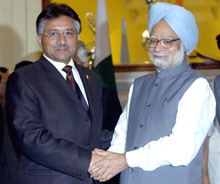
Musharraf and Singh have made up!

Apparently they went into a room by themselves, without aides, security, etc. Locked themselves inside for an hour. When they emerged, an agreement had been struck to resume peace talks! See, all they needed was some alone time to do the nasty, and all is now well. And to those of you who are grossed out by the thought of either Musharraf or Singh having sex, well, have some compassion for the ugly people on the planet - they need sex too.

Saturday, September 16, 2006

Blair most hated by Britons?

While all these negotiations continue - between Blair and other Labourites on when exactly he will leave, between Blair and the LSE - it seems that no one will really miss him much when he's gone. A poll from this month shows Blair with only 1 23% approval rating (that makes Bush's 36% practically a superstar).

Blair was also voted "most hated" by Britons in 2003. Interestingly, that same survey has gay rights missionary and generally misguided fool Peter Tatchell at number 80. You can see the full results here.

Blair School of Government?

Fresh from the news that Tony Blair will resign within a year comes word that Tony is worried about his "legacy." I guess I would worry too if I thought my only legacy was going to be showing the world how to be a good lapdog. Anyway, apparently Blair's people have been in dialogue with folks from the London School of Economics (LSE) about setting up a school of government/public policy named after Blair:

British Prime Minister Tony Blair’s chief of staff is in discussions with the London School of Economics over the establishment of a school of government in Mr Blair’s name, the Guardian reported on Friday.

Citing unnamed LSE academics involved in the discussions, which have apparently been ongoing for six months, the newspaper reported that the proposed school would focus on foreign and domestic policy.

Mr Blair has apparently been inspired by Harvard University’s John F. Kennedy School of Government, and former US president Bill Clinton’s foundation, in attempting to cement his legacy.


I've been at academic institutions where some academic divisions are named for prominent politicians, and it's very tricky to try and keep the academic endeavor separate from the very real idetification of the institution with the politician's ideology. Such questions have already been raised at LSE:

There remain questions over whether Mr Blair would actually head the school, the unnamed academics told the Guardian, and the Prime Minister’s chief of Staff Jonathan Powell has also been mentioned as a possible head. The LSE was apparently enthusiastic initially when discussions began, but the newspaper reported that some academics are wary of the proposal, questioning whether Mr Blair’s involvement would compromise the LSE’s independence.

"It would need to be de-Blairified before it could go ahead," one unnamed academic said. Both Howard Davies, the LSE’s director, and Mr Blair’s Downing Street office denied knowledge of such a proposal, though it was confirmed by various academics at the LSE off the record to the newspaper.


If I were the LSE, I would run, fast, in the opposite direction...

Monday, September 04, 2006

Desis United?

As FOBs, we tend not to spend too much time about what it means to be desi in the West. Our psychic identities are firmly rooted in the "homeland," which removes an entire level of complication from our lives. (Having seen some of this complication up close and personal, I'd say this is a huge blessing.) Especially here at HOMOfobia, we share such a close personal and political bond that questions about "who we are" rarely come up.

But every once in a while, I come across a story that reminds me of how fractured the desi diaspora really is. There are, of course, countless tensions and questions that accompany the often-forced and arbitrary transformation of regional and national communities into a geographically-dispersed "diaspora." But increasingly I've been seeing another variation on the theme, which highlights the perceived dissonance of one community with the rest of the diaspora. Here's one such story from the UK, which discusses the increasing economic success of "Asians" in Britain (as South Asians are referred to in the UK). The article talks about the changing class character of the Asian community, which is apparently becoming more prosperous and leaving behind its working-class origins. But then something right at the end of the article caught my eye:

But sections of Britain’s thriving ‘new Asian economy’ complained to TOI on Monday that it might have been better for the new Barclays Bank report to have categorically classified the growth as "Indian rather than Asian because it may be misleading to lump all Asians together".

Tushar Patel, who has a chain of pharmaceuticals, said, "There is such a wide difference between ‘Asian’ groups - Indian, Pakistani and Bangladeshi - that it would be better to be more specific about who is doing well”. [emphasis added]


Maybe I'm just being naive, but is it really so hard to maintain some kind of solidarity with other desis?