Wednesday, September 20, 2006
Shazia Sikander Wins "Genius" Grant
Shazia Sikander, an artist from Lahore, has received the "genius" grant from MacArthur Foundation.


Monday, September 18, 2006
The A-List Says No to Section 377
Vikram Seth, along with many other sparkling luminaries, has written an open letter to the Indian government asking for a repeal of Section 377. In addition to Seth, other prominent folks include Pooja Bedi, Nandita Das, Shobhaa De, Barkha Dutt (of Kargil-coverage fame), Soha Ali Khan, Shubha Mudgal, Mira Nair, Amol Palekar, Arundhati Roy, Aparna Sen, and Konkona Sen, among others. Along with the actually-famous people like the above are also a host of "star" academics. Of course none of the HomoFOBs were asked to sign. Guess we're not hip enough.
A full list of the signatories can be seen here, along with the text of the letter.
A full list of the signatories can be seen here, along with the text of the letter.
Sunday, September 17, 2006
Our Men in Havana
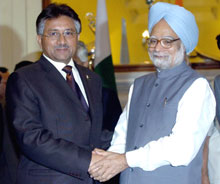
Musharraf and Singh have made up!
Apparently they went into a room by themselves, without aides, security, etc. Locked themselves inside for an hour. When they emerged, an agreement had been struck to resume peace talks! See, all they needed was some alone time to do the nasty, and all is now well. And to those of you who are grossed out by the thought of either Musharraf or Singh having sex, well, have some compassion for the ugly people on the planet - they need sex too.
Saturday, September 16, 2006
Blair most hated by Britons?
While all these negotiations continue - between Blair and other Labourites on when exactly he will leave, between Blair and the LSE - it seems that no one will really miss him much when he's gone. A poll from this month shows Blair with only 1 23% approval rating (that makes Bush's 36% practically a superstar).
Blair was also voted "most hated" by Britons in 2003. Interestingly, that same survey has gay rights missionary and generally misguided fool Peter Tatchell at number 80. You can see the full results here.
Blair was also voted "most hated" by Britons in 2003. Interestingly, that same survey has gay rights missionary and generally misguided fool Peter Tatchell at number 80. You can see the full results here.
Blair School of Government?
Fresh from the news that Tony Blair will resign within a year comes word that Tony is worried about his "legacy." I guess I would worry too if I thought my only legacy was going to be showing the world how to be a good lapdog. Anyway, apparently Blair's people have been in dialogue with folks from the London School of Economics (LSE) about setting up a school of government/public policy named after Blair:
I've been at academic institutions where some academic divisions are named for prominent politicians, and it's very tricky to try and keep the academic endeavor separate from the very real idetification of the institution with the politician's ideology. Such questions have already been raised at LSE:
If I were the LSE, I would run, fast, in the opposite direction...
British Prime Minister Tony Blair’s chief of staff is in discussions with the London School of Economics over the establishment of a school of government in Mr Blair’s name, the Guardian reported on Friday.
Citing unnamed LSE academics involved in the discussions, which have apparently been ongoing for six months, the newspaper reported that the proposed school would focus on foreign and domestic policy.
Mr Blair has apparently been inspired by Harvard University’s John F. Kennedy School of Government, and former US president Bill Clinton’s foundation, in attempting to cement his legacy.
I've been at academic institutions where some academic divisions are named for prominent politicians, and it's very tricky to try and keep the academic endeavor separate from the very real idetification of the institution with the politician's ideology. Such questions have already been raised at LSE:
There remain questions over whether Mr Blair would actually head the school, the unnamed academics told the Guardian, and the Prime Minister’s chief of Staff Jonathan Powell has also been mentioned as a possible head. The LSE was apparently enthusiastic initially when discussions began, but the newspaper reported that some academics are wary of the proposal, questioning whether Mr Blair’s involvement would compromise the LSE’s independence.
"It would need to be de-Blairified before it could go ahead," one unnamed academic said. Both Howard Davies, the LSE’s director, and Mr Blair’s Downing Street office denied knowledge of such a proposal, though it was confirmed by various academics at the LSE off the record to the newspaper.
If I were the LSE, I would run, fast, in the opposite direction...
Monday, September 04, 2006
Desis United?
As FOBs, we tend not to spend too much time about what it means to be desi in the West. Our psychic identities are firmly rooted in the "homeland," which removes an entire level of complication from our lives. (Having seen some of this complication up close and personal, I'd say this is a huge blessing.) Especially here at HOMOfobia, we share such a close personal and political bond that questions about "who we are" rarely come up.
But every once in a while, I come across a story that reminds me of how fractured the desi diaspora really is. There are, of course, countless tensions and questions that accompany the often-forced and arbitrary transformation of regional and national communities into a geographically-dispersed "diaspora." But increasingly I've been seeing another variation on the theme, which highlights the perceived dissonance of one community with the rest of the diaspora. Here's one such story from the UK, which discusses the increasing economic success of "Asians" in Britain (as South Asians are referred to in the UK). The article talks about the changing class character of the Asian community, which is apparently becoming more prosperous and leaving behind its working-class origins. But then something right at the end of the article caught my eye:
Maybe I'm just being naive, but is it really so hard to maintain some kind of solidarity with other desis?
But every once in a while, I come across a story that reminds me of how fractured the desi diaspora really is. There are, of course, countless tensions and questions that accompany the often-forced and arbitrary transformation of regional and national communities into a geographically-dispersed "diaspora." But increasingly I've been seeing another variation on the theme, which highlights the perceived dissonance of one community with the rest of the diaspora. Here's one such story from the UK, which discusses the increasing economic success of "Asians" in Britain (as South Asians are referred to in the UK). The article talks about the changing class character of the Asian community, which is apparently becoming more prosperous and leaving behind its working-class origins. But then something right at the end of the article caught my eye:
But sections of Britain’s thriving ‘new Asian economy’ complained to TOI on Monday that it might have been better for the new Barclays Bank report to have categorically classified the growth as "Indian rather than Asian because it may be misleading to lump all Asians together".
Tushar Patel, who has a chain of pharmaceuticals, said, "There is such a wide difference between ‘Asian’ groups - Indian, Pakistani and Bangladeshi - that it would be better to be more specific about who is doing well”. [emphasis added]
Maybe I'm just being naive, but is it really so hard to maintain some kind of solidarity with other desis?
Tuesday, August 29, 2006
Back in the Classroom
Today was the first day of classes for me this semester. Groan. While I love teaching, I must say that it seems more and more difficult to start teaching again every semester. And perhaps it's also become much more predictable - what the students will say, what they will want, what they refuse to "get." And this semester is going to be maybe my hardest ever, with tons of work, and I'm not looking forward to it. Meanwhile, I am seriously in love. With my phone. It's just beautiful, and exactly what was I was looking for in the last 1.5 years of my search for a new phone. And I can now text to Pakistan, India, UK... anywhere in the world my heart desires. Well, that would probably exclude Latvia, where they recently held anti-gay protests as activists were trying to stage a gay pride event.

Now, usually anti-gay protestors don't amuse me, but these morons are just so silly! Look at their T-shirts! What a bunch of freaks. By the way, similar protests happened in Estonia, Lithuania, and Russia.

Now, usually anti-gay protestors don't amuse me, but these morons are just so silly! Look at their T-shirts! What a bunch of freaks. By the way, similar protests happened in Estonia, Lithuania, and Russia.
Monday, August 28, 2006
Pakistanis Denied Entry Into U.S.
Two family members of one of the "Lodi group" have been denied entry into the U.S.:
Both men are U.S. citizens, and do not hold dual Pakistani nationality. They tried to come back earlier in April, but were turned back from Hong Kong airport, where they had to pay for their own flight back to Islamabad! Apparently the U.S. government has put them on the "no-fly" list (is it a matter of time before all the homoFOBS are on that list??!?). The FBI is demanding that they submit to an interview in Islamabad, without lawyers present! They have already submitted to an FBI interview earlier in the year. The FBI also wants them to take polygraph tests. They have so far refused to do so, and a lawyer from the ACLU is handling their case.
Hell, why don't they just go ahead and make it a law forbidding entry into the U.S. for brown people? Why don't they just go ahead and set up those internment camps already? Who are they kidding?
Muhammad Ismail, a 45-year-old naturalized citizen born in Pakistan, and his 18-year-old son, Jaber Ismail, who was born in the United States, have not been charged with a crime. However, they are the uncle and cousin of Hamid Hayat, a 23-year-old Lodi cherry packer who was convicted in April of supporting terrorists by attending a Pakistani training camp.
Federal authorities said Friday that the men, both Lodi residents, would not be allowed back into the country unless they agreed to FBI interrogations in Pakistan. An attorney representing the family said agents have asked whether the younger Ismail trained in terrorist camps in Pakistan.
Both men are U.S. citizens, and do not hold dual Pakistani nationality. They tried to come back earlier in April, but were turned back from Hong Kong airport, where they had to pay for their own flight back to Islamabad! Apparently the U.S. government has put them on the "no-fly" list (is it a matter of time before all the homoFOBS are on that list??!?). The FBI is demanding that they submit to an interview in Islamabad, without lawyers present! They have already submitted to an FBI interview earlier in the year. The FBI also wants them to take polygraph tests. They have so far refused to do so, and a lawyer from the ACLU is handling their case.
Hell, why don't they just go ahead and make it a law forbidding entry into the U.S. for brown people? Why don't they just go ahead and set up those internment camps already? Who are they kidding?
cricket and compulsory national identity
Like so many South Asians, I have always known that the sense of joy I feel at seeing someone crack a cricket ball off into the distance is entirely wrapped up in the politics of my past, present and future.
The current furore about alleged 'ball tampering' by the Pakistani cricket team brought home to me yet again that cricket has been irrecoverably stolen by the false pretensions of national identity. Of course, for so many of us, this is hardly news. We grew up in a subcontinental political world where the blood thirsty fantasies of our insecure politicians were regularly translated into the heat and dust of the cricket pitch. But this time it is England that has re-triangulated that dynamic: the dying imperialist power stokes seething passions by one, quick, racist allegation. And yet again, the national authorities of the postcolonial countries - in this case, India - fall over themselves to discredit any hope for postcolonial solidarity. This despite the real and growing support amongst Indians on-the-ground for Pakistan, and repeated statements of disgust at the racist actions of the umpire.
I took this photograph from behind the Taj in January of 2006. I think the barbed wires framing that symbol of a pre-national cultural ecumeme, displaced upon the shadowy figures of young boys playing cricket on the rapidly drying banks of the once vibrant river Jamna speaks volumes to the present state of Hindutva, forced national identity, subcontinental cultures trapped behind national pretensions, and the ever lasting sound of 'aaaauuuuuuuuuuuuuuut!'

With love and kisses to all homoFOBs everywhere,
Shefali.
Sunday, August 27, 2006
Bugti Dead. Now What?
Akbar Bugti was killed on Saturday in a military operation. Unconfirmed news reports also claim that two of his grandons were killed as well. On Sunday, Quetta exploded in violence. (So did parts of Karachi.)
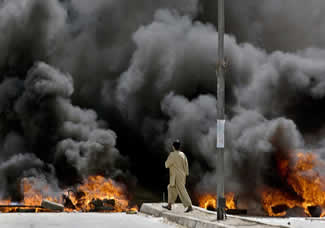
My sister texted me from Islamabad, wondering, "is this another Bangladesh"? In some ways, she's right, because the Baluch nationalists feel as aggrieved as the erstwhile East Pakistanis did. At this juncture, the two main factors that are responsible for the Baluchistan situation are perhaps ratcheted up to their highest level: the economic exploitation of Baluchistan (mainly natural gas), and the brutal military repression and occupation of the region. The last Baluchistan crisis was in the 1970s, but that was eventually forcibly suppressed, with the military especially keen to hold on to a restive province immediately after another one had been "lost." This time around, a military government is in power, which enjoys (on most days) the support of the U.S., and which can use the convenient ruse of the "War on Terror" to crack down on any and all domestic opponents.
This, by the way, is not meant to be a tribute to Bugti. But he was held in high regard and affection by his people, and his death may yet prove to be one of those highly charged symbolic events that finally galvanize a people past the tipping point. In any case, I fear there will be much more violence to come in the immediate future, whatever happens.
In a weird coincidence, the U.S.-based Armed Forces Journal recently published an argument for redrawing boundaries in the "Greater Middle East," which includes Pakistan. According to this argument, Baluchistan would become an independent country. (Pakistan would be downsized to existing Punjab and Sindh only, with NWFP going to Afghanistan.) This is completely counter to what the Pakistan establishment wants, but it is a chilling reminder of the kind of influence and ambition U.S. policymakers have in the region.
Subscribe to:
Posts (Atom)
